
 When my daughter-in-law proudly announced that our 2nd grade grandson, Liam, was participating in a school program portrayed as Jackie Robinson, I penciled the date in the calendar. Aware of my avid interest in the game and the social and human interest stories that accompany baseball, she knew I’d have an interest beyond my support for seeing my grandson in his school “learner” mode.
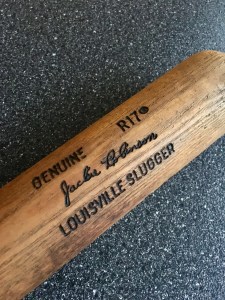
I immediately shared that I had my Louisville Slugger Jackie Robinson bat I used nearly 50 years ago as a player in the Portland (Maine) Twilight League. The bat became more valued to me as time passed because of its unique design (a thick handled bat versus the more commonly thinly tapered ones) and because of the autograph burned into the wood – Jackie Robinson, the first African-American to play major league baseball. My wonder was whether my grandson would like the bat as a prop. In the end, I decided I would offer him the bat as a keepsake now that he was an eight year old expert on Jackie Robinson. On the morning of the school program, I polished the bat once again with wood oil and off to Harrisonburg my wife and I went.
What I did not know was the full context of the program. Upon arrival at the elementary school, I observed the cafeteria converted to the Famous American Museum. As student presenters entered with their respective classes, they took to their stations behinds podiums or tables, dressed in the garb of the day and taking on the persona of their chosen famous American.
With the backdrop of our country’s discussion of immigration policy and practices, I could only appreciate the diversity of the students and their selected famous Americans. As each presented their prepared autobiographical statements, I was taken by the theme of their choices – people who advocated during different times in our history for social justice and equality. What I appreciated even more so was being in an elementary school that is part of a 6,000 student school district in which over 50 languages are spoken. Our world is changing.
The famous Americans included Ben Franklin, Eleanor Roosevelt, Dr. Martin Luther King, Rosa Parks, Che Guevara, Abraham Lincoln, Rosa Parks, George Washington, Ruby Bridges, Thurgood Marshall, #42 Jackie RobinsonFamous American Museum and others – choices reflecting diversity similar to the student body. As these eight year olds proudly shared their biographical backgrounds and accomplishments, I could not help but appreciate the timing of this event with this week’s 50th anniversary of Martin Luther King’s assassination. His work and his life were not forgotten on this day at The Famous American Museum. Our world is changing.
These performance events in schools are not unusual. Modern day education is a smarter delivery system than years ago and is responsive in many ways to the wide range of students’ needs as they experience our nation’s public school system. Often schools are only restricted by the resources available to teachers and principals, The program was a compelling display of social issues, American history, oral and written language, public speaking, collaboration and team work, engagement of parents and community members in the education process and a statement to the students of others interest in their education – including total strangers who chose to hear the students’ personalized presentations.
To experience these young learners speak of famous Americans who represented different issues, different times, and different backgrounds was thought-provoking and heartwarming. To experience children of this age representing people of their own color or heritage was noteworthy. Our world is changing.
As the program ended, we shared our good-byes and appreciations with Liam. The students returned to classes. The adults returned to their respective world of responsibilities. I gave the Jackie Robinson model baseball bat to my daughter-in-law to give to Liam upon his return home. I found his response to be one of awe due to the Jackie Robinson signature and one that recognized that the bat just might be special enough to warrant safe keeping. I suggested he keep the bat with the signed baseball I gave him upon birth that I knew he would someday appreciate the story and the significance (along with his Dad’s and Papa’s love for the game!). The baseball was autographed by Buck O’Neill shortly before his death at 95 years old. O’Neill played in the Negro Leagues for over a decade. He led the way establishing the Negro Leagues Baseball Museum in Kansas City, MO. The Negro Leagues – another story, for another time, of our country’s history relating to social justice and equality. Our world is changing. For the better.
Thanks to the staff at Stone Spring Elementary School in Harrisonburg, VA. And thanks to Liam for the invite!


 Pearse Reid Associates